

Burnout at work in the Netherlands is not only a medical or personal problem. It can also become an employment law issue.
An employee may be unable to work because of exhaustion, stress, anxiety, sleep problems or psychological complaints caused by work pressure. At the same time, the employer may continue asking for performance, availability, reintegration, meetings or even a settlement agreement.
This is where Dutch employment law becomes important.
In the Netherlands, employers have duties around safe working conditions, work pressure, sick leave and reintegration. Employees also have rights, but they must handle sick leave and communication carefully.
This guide explains what employees should know about burnout at work in the Netherlands, including employee rights, employer duties and legal options.
This article is general information as of June 2026. Your personal position may depend on your employment contract, CAO, company doctor advice, UWV situation, residence permit and the facts of your case.
Burnout at work in the Netherlands: why it becomes a legal issue
Burnout is often connected to long-term stress, excessive workload, unclear expectations, workplace conflict, bullying, poor management or constant pressure to perform.
Under Dutch workplace rules, work pressure is treated as part of psychosocial workload. The Netherlands Labour Authority explains that work pressure can become excessive when the demands of the job are no longer in balance with the employee’s capacity, and that excessive work pressure can lead to stress, absenteeism, long-term sick leave and burnout.
This means that work-related burnout is not just a private health issue. It may raise questions such as:
- Can I report sick for burnout?
- Does my employer have to pay my salary?
- Can my employer ask what diagnosis I have?
- Can I be forced to return to work?
- Can I be dismissed while sick?
- Can I claim compensation if the employer caused the burnout?
These questions should be handled carefully, especially if there is already a conflict with the employer.
Burnout, work pressure and psychosocial workload
Dutch employers must provide safe and healthy working conditions. This applies to all employees in the Netherlands, including foreign workers, temporary staff and subcontractor employees.
A safe workplace does not only mean preventing physical accidents. It also includes psychological risks, such as excessive workload, bullying, discrimination, aggression, intimidation and unsafe workplace culture.
Employers must identify health and safety risks through a Risk Assessment & Evaluation, known in Dutch as the RI&E. The RI&E must describe risks to employee health and safety and include a plan of action with measures to address those risks.
If work pressure is a real risk in the organisation, the employer should not ignore it. A proper approach may include investigating workload, identifying bottlenecks, taking measures, adjusting staffing or deadlines, improving management practices, and evaluating whether the measures actually work.
When burnout becomes sick leave
If burnout makes you unable to perform your work, it may be treated as sickness under Dutch employment law.
You do not need to use the exact word “burnout” when reporting sick. You may simply report that you are ill and unable to work. Your employer may ask practical questions, such as when you expect to be reachable or whether temporary adjusted work may be possible later. But your employer may not force you to disclose medical details.
Business.gov.nl explains that a sick employee does not have to tell the employer what is going on, and the employer is not allowed to ask for the medical reason.
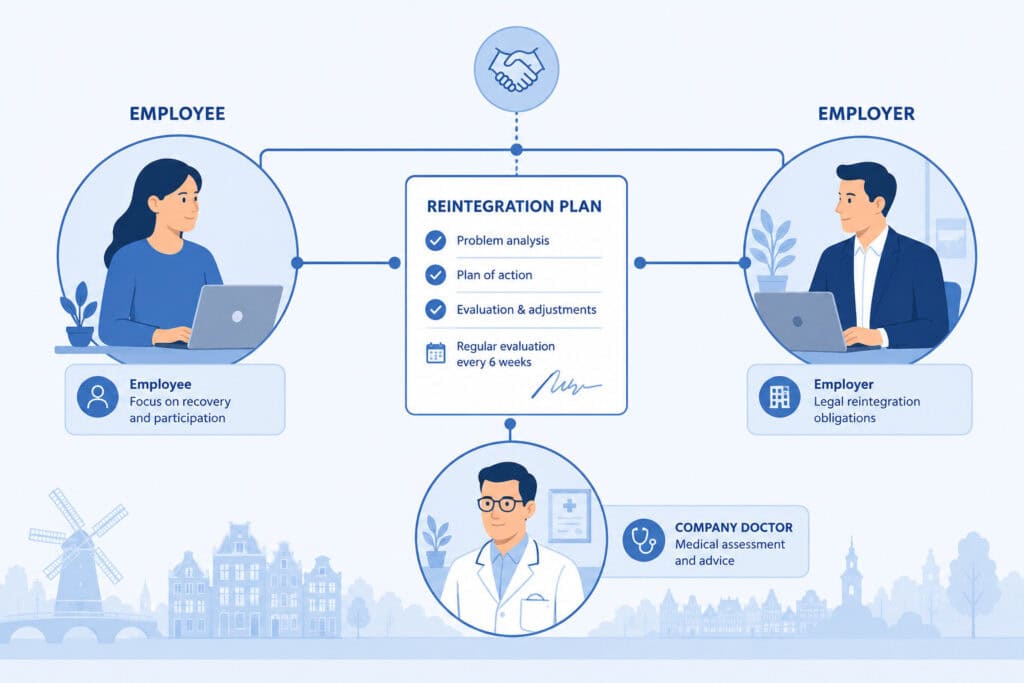
In practice, the company doctor, or bedrijfsarts, plays an important role. The company doctor assesses your work capacity and advises on reintegration. Your GP, psychologist or therapist may treat you medically, but the company doctor usually advises the employer about what you can and cannot do for work.
Employee rights when you suffer burnout
1. Right to report sick
If you are genuinely unable to work because of burnout symptoms, you can report sick according to your employer’s sickness policy.
Do this clearly and calmly. Follow the internal procedure. For example, notify your manager or HR through the required channel and keep proof of your sick report.
You do not need to write a long medical explanation. A simple message is usually enough:
“I am ill and unable to work today. I will follow the sickness reporting procedure and remain available for contact with the company doctor.”
If the burnout is linked to work pressure, you can later discuss the work-related causes with the company doctor and, where appropriate, with HR or your employer.
2. Right to medical privacy
One of the most common employee questions is:
“My manager keeps asking what is wrong with me. Do I have to explain my diagnosis?”
In general, no. You do not have to tell your employer your diagnosis, symptoms, medication, therapy details or private medical history.
Your employer may need practical information to manage the workplace and sick leave process. But medical assessment belongs with the company doctor, not your line manager.
This matters in burnout cases because employees often feel pressured to prove that they are “really sick.” Avoid oversharing medical details in emails, WhatsApp messages or HR meetings before you understand the legal consequences.
3. Right to salary during sickness
In most employment situations, if you are sick, your employer must continue paying salary for a maximum of two years. Business.gov.nl states that an employer must pay at least 70% of the employee’s last-earned wages for up to two years and must also make reintegration efforts.
In the first year, if 70% would fall below the statutory minimum wage, the employer must supplement it up to the minimum wage. In the second year, the minimum wage supplement does not apply in the same way. Your employment contract or CAO may provide better rights, such as 100% salary for part of the sickness period.
Practical example:
An employee in Amsterdam reports sick due to work-related burnout after months of excessive overtime and pressure. Their employer cannot simply stop salary because the employee is absent. The employer must follow the sick leave and reintegration rules. However, the employee must also cooperate with reasonable reintegration steps.
4. Right to company doctor involvement
If you are sick, the employer must involve the company doctor or occupational health and safety service. For longer-term sickness, the employer and employee must work together on reintegration. Business.gov.nl explains that the employer must call in a company doctor or health and safety service, with a problem analysis usually after six weeks and a plan of action in week eight. Progress meetings should generally take place every six weeks.
For burnout, the company doctor may advise:
- temporary full rest from work;educed contact with the employer;
- gradual reintegration;
- reduced hours;
- adjusted tasks;
- no deadlines or client pressure;
- mediation if there is a workplace conflict;
- a second-track reintegration process if return to the employer is not realistic.
The advice should focus on what is medically and occupationally responsible.
5. Right to a second opinion
Another common employee question is:
“The company doctor says I can start working again, but I still cannot function. What can I do?”
If you disagree with the company doctor’s opinion, you may have the right to request a second opinion from another company doctor. Business.gov.nl states that an ill employee has the legal right to consult the company doctor and, if in doubt about the doctor’s opinion, to ask for a second opinion from a different company doctor or occupational health and safety agency; the employer must pay for these expenses.
A second opinion is not the same as a UWV expert opinion. If reintegration is stuck because you and your employer disagree, a UWV expert opinion may also be relevant. UWV explains that employer and employee can request an expert opinion about, among other things, whether the employee can work, whether proposed work is suitable, and whether either party has done enough for reintegration.
Employer duties in burnout and work pressure cases
Duty to prevent excessive work pressure
Employers in the Netherlands must take work pressure seriously.
The Netherlands Labour Authority states that employers must establish a policy to combat long-term excessive work pressure and that this is required under the Working Conditions Act.
This does not mean every stressful day creates employer liability. Work can be busy. Deadlines can exist. But when workload becomes structurally excessive, when employees repeatedly raise concerns, or when management ignores warning signs, legal risk may increase.
Duty to have a psychosocial workload policy
Employers must draw up a policy against psychosocial workload as part of their health and safety policy. Business.gov.nl explains that the policy should be based on the RI&E, describe when employees could suffer psychosocial workload, identify possible causes and include measures to prevent and reduce it.
Such measures may include:
- clear workload monitoring;realistic deadlines;
- anti-bullying and anti-harassment procedures;
- a confidential adviser;
- complaints procedures;
- training for managers;
- adjustments for teams with high absenteeism;
- regular evaluation of whether measures work.
If an employer has a policy on paper but does nothing in practice, that may not be enough.
Duty to adjust work during reintegration
During sick leave, the employer must support responsible reintegration. This can include adjusting tasks, working times, workstation and working hours where possible.
For burnout, this is especially important. A rushed return to the same workload may cause relapse.
Practical example:
An employee returns after six weeks of burnout-related sickness. The company doctor advises two hours per day of low-pressure internal tasks. The employer immediately assigns urgent client deadlines and performance targets. This may conflict with responsible reintegration and should be challenged in writing.
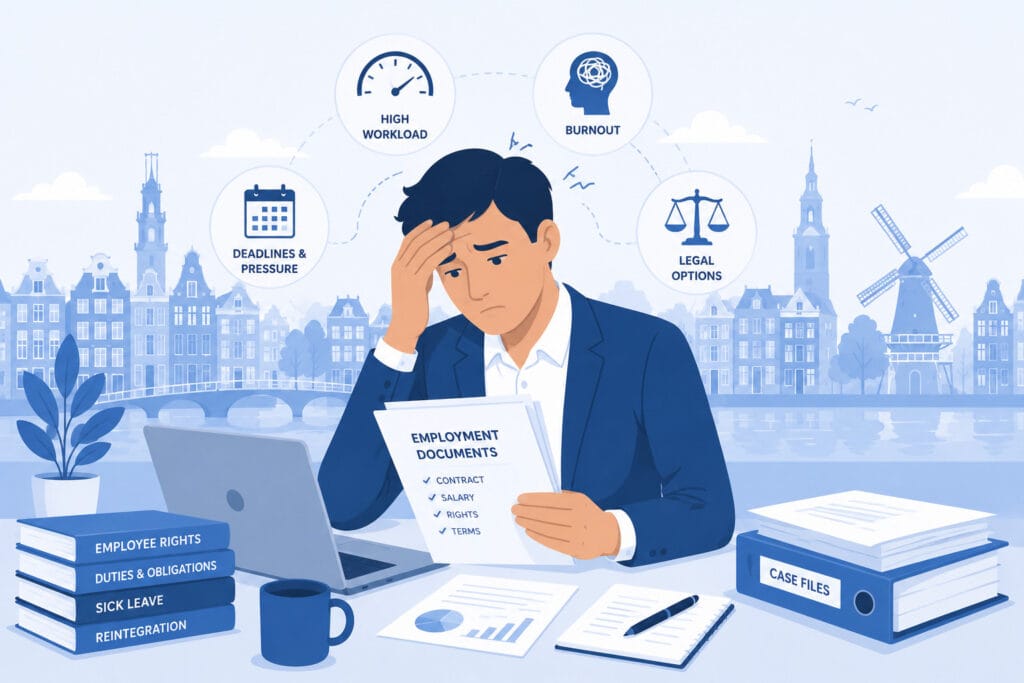
Can your employer dismiss you during burnout sick leave?
Many employees fear that reporting burnout will lead to dismissal.
In the Netherlands, an employee is generally protected against dismissal during the first two years of illness. The Dutch government states that during the first two years of sickness or incapacity for work, the employee may not be dismissed, subject to exceptions. After two years, the employer may apply to UWV for dismissal.
This protection does not mean you can ignore reintegration. If you refuse reasonable cooperation without a valid reason, the employer may take measures. Business.gov.nl notes that the employee must cooperate in reintegration efforts and that insufficient cooperation can even become grounds for dismissal.
Common exceptions
Dismissal may still be possible in specific situations, such as:
- dismissal during a valid probationary period;instant dismissal for serious misconduct;
- bankruptcy;
- a temporary contract ending by operation of law;
- failure to cooperate with reintegration without good reason;
- dismissal after two years of sickness if legal conditions are met.
Never assume that a dismissal threat is valid. Also never assume it is harmless. Get legal advice quickly if your employer mentions dismissal, salary stop or settlement while you are sick.
Be careful with settlement agreements while sick
Another common question is:
“My employer offered me a settlement agreement while I am burned out. Should I sign?”
Be very careful.
A settlement agreement, or vaststellingsovereenkomst, can have major consequences for salary, sickness benefits, unemployment benefits, transition payment, final settlement, non-compete clauses and residence rights.
UWV warns that it is not wise for a sick employee to simply sign a settlement or termination agreement. If the employee is still sick and incapacitated at the time of signing, they will probably not receive a Sickness Benefits Act benefit.
For this reason, a sick employee should not sign under pressure. Ask for time. Request the document. Do not agree verbally. Do not send messages such as “I accept” before legal review.
This is especially important if the employer frames the agreement as “better for your recovery” or “just an administrative solution.”
What if your employer caused or worsened your burnout?
Some employees ask:
“My burnout happened because of impossible workload and toxic management. Can I hold my employer responsible?”
Possibly, but this is legally complex.
A work-related burnout claim usually requires more than saying the job was stressful. You may need to show that:
- there was serious or structural work pressure;the employer knew or should have known about the risk;
- you raised concerns, or the risk was otherwise visible;
- the employer failed to take reasonable measures;
- you suffered actual psychological damage;
- there is a causal link between the work conditions and the damage.
- Evidence can be very important.
- Useful evidence may include:
- emails about excessive workload;
- messages showing repeated overtime;
- planning documents or impossible targets;
- performance pressure while sick;
- complaints to HR or management;
- company doctor advice;
- GP or psychologist records;
- witness statements;
- absence patterns in the team;
- records of bullying, intimidation or discrimination;
- proof that the employer ignored earlier warnings.
Because psychological damage cases are fact-sensitive, legal advice is important before making accusations or claiming compensation.
Practical steps if you are burned out because of work
Step 1: Document what is happening
Write down a timeline. Include workload, overtime, deadlines, staffing problems, conflicts, warnings you gave, symptoms, sick reports, company doctor appointments and employer responses.
Keep copies of important emails and documents. Do not secretly record conversations without advice. Do not remove confidential company information.
Step 2: Raise workload concerns in writing
If you are still working but close to burnout, raise concerns early. Arboportaal advises employees to speak up in time when work pressure is too high and to discuss what is needed.
A useful message can be:
“I am experiencing the current workload as too high and I am concerned about my health. I would like to discuss priorities, deadlines and possible adjustments.”
This creates a record that the employer was informed.
Step 3: Use the company doctor
You can ask for contact with the company doctor, especially if work pressure is affecting your health. Arboportaal also advises employees to seek help and, for example, request a preventive consultation with the company doctor or speak with a confidential adviser.
Tell the company doctor clearly:
- what your symptoms are;what work factors contribute to them;
- what happens when employer contact increases;
- whether you can perform any work safely;
- what adjustments may help;
- whether there is a workplace conflict.
Step 4: Be careful with reintegration pressure
Reintegration should support recovery, not punish illness.
If your employer pressures you to return faster than medically responsible, respond in writing and refer to the company doctor’s advice. If the company doctor’s advice is unclear or unrealistic, ask for clarification, a second opinion or legal advice.
Do not simply refuse all contact without explanation. But also do not agree to tasks that are clearly inconsistent with medical advice.
Step 5: Do not sign anything under pressure
Before signing a settlement agreement, warning letter, salary reduction, resignation letter, performance improvement plan or reintegration document you disagree with, seek advice.
This is especially important if:
- you are still sick;you are being blamed for the burnout;
- your salary is threatened;
- your employer says the working relationship is damaged;
- you have a highly skilled migrant permit;
- you are close to two years of illness;
- you disagree with the company doctor;
- you are being asked to return too quickly.
Special concerns for expats and highly skilled migrants
Burnout can be even more stressful for expats and international employees.
You may not know the Dutch sick leave system. Your manager may not explain your rights clearly. You may worry that reporting sick will affect your residence permit. You may also feel pressure because your employer is your recognised sponsor.
For highly skilled migrants, employment termination can affect residence rights. IND states that only an employer recognised by IND can apply for a highly skilled migrant permit, and that the residence permit is valid for the period of the contract or job, up to a maximum of five years. IND also states that a job-search period may apply after job loss, but this depends on the latest rules and the validity of the permit.
Therefore, if you are an expat or highly skilled migrant, do not evaluate a settlement agreement only from an employment law perspective. Check immigration consequences as well. Current IND rules, salary thresholds and residence conditions must always be checked against the latest official rules before any decision is made.
Legal options for employees with work-related burnout
Depending on your situation, your options may include:
- requesting proper involvement of the company doctor;asking for workload adjustments;
- requesting a second opinion;
- requesting a UWV expert opinion if reintegration is stuck;
- challenging a salary stop;
- objecting to dismissal pressure;
- negotiating or rejecting a settlement agreement;
- making a formal complaint about unsafe working conditions;
- addressing bullying, harassment or discrimination;
- claiming damages in serious cases where the employer breached duties and caused psychological harm.
The right option depends on timing. For example, the best step before signing a settlement agreement may be very different from the best step during reintegration or after a salary stop.
FAQ: burnout employee rights in the Netherlands
Can I report sick for burnout in the Netherlands?
Yes. If your symptoms make you unable to work, you can report sick according to your employer’s sickness policy. You do not need to disclose your full medical diagnosis to your employer.
Do I have to tell my employer that I have burnout?
You do not have to tell your employer your medical diagnosis. You may choose to share limited information, but be careful. Medical details should normally be discussed with the company doctor.
Can my employer ask what exactly is wrong with me?
Your employer may ask practical questions, but may not require you to explain your medical condition. Business.gov.nl states that a sick employee does not have to tell the employer what is going on, and the employer is not allowed to ask for it.
Will I receive salary during burnout sick leave?
Usually yes, if you are an employee and unable to work due to sickness. In general, the employer must pay at least 70% of the last-earned wages for up to two years, although your contract or CAO may provide more.
Can my employer force me to return before I am ready?
Your employer may require cooperation with reintegration, but reintegration should be medically responsible. The company doctor’s advice is central. If you disagree with that advice, you may request a second opinion or consider a UWV expert opinion.
What if the company doctor says I can work but my GP disagrees?
This happens often. The GP treats you medically, while the company doctor assesses work capacity. Ask the company doctor to explain the advice clearly. You may request a second opinion from another company doctor if you doubt the opinion.
Can I be fired while on sick leave for burnout?
During the first two years of illness, dismissal is generally prohibited, subject to exceptions. After two years, dismissal may become possible through UWV if the conditions are met.
Can my employer stop my salary if I do not reintegrate?
Possibly, but only under specific conditions. Employees must cooperate with reasonable reintegration. If you believe the reintegration request is harmful or unrealistic, respond in writing, refer to medical advice and seek legal advice quickly.
Should I sign a settlement agreement while burned out?
Not without legal advice. Signing while sick can seriously affect benefits and legal protection. UWV warns that it is not wise for a sick employee to simply sign a settlement or termination agreement.
Can I claim compensation if my employer caused my burnout?
Possibly, but it depends on evidence. You may need to prove serious work-related causes, employer knowledge, failure to act, psychological damage and causation. These cases are complex and should be assessed individually.
What should I do if my manager keeps pressuring me?
Keep communication written and professional. Ask for company doctor involvement. Do not disclose unnecessary medical details. If pressure continues, seek legal advice, especially if salary, dismissal or settlement is mentioned.
What should expats check?
Expats should check both employment law and immigration consequences. Highly skilled migrants and other residence-permit holders should be particularly careful before agreeing to termination, because employment changes can affect residence rights. IND rules and salary requirements must always be checked against the latest official information.
Need legal advice about burnout at work in the Netherlands?
Burnout at work can quickly become a legal problem.
A sick report may turn into a dispute about salary, privacy, reintegration, company doctor advice, dismissal, UWV benefits, psychological damage or a settlement agreement. For expats and highly skilled migrants, the consequences can also affect residence rights.
DYC Legal Consultancy assists employees, Turkish-speaking clients, expats and international professionals in the Netherlands with sick leave, burnout-related employer pressure, settlement agreements, dismissal issues and employment-related immigration concerns.
Before you sign a settlement agreement, accept a salary stop, resign, refuse reintegration, or respond to employer pressure, seek legal advice.
Contact DYC Legal Consultancy for a confidential consultation about your burnout, sick leave and employment law position in the Netherlands.
References
Work Pressure and Burnout Risks in the Netherlands – https://www.nllabourauthority.nl/topics/working-conditions-act/work-pressure-and-undesirable-behaviour/work-pressure
Working Conditions for Employees in the Netherlands – https://business.gov.nl/regulations/working-conditions-employees/
Psychosocial Workload Policy for Employers – https://business.gov.nl/staff/health-and-safety/creating-a-psychosocial-workload-policy/
Risk Inventory and Evaluation RI&E – https://business.gov.nl/regulations/risk-inventory-evaluation/
Sick Pay Rules in the Netherlands – https://business.gov.nl/regulations/sick-pay/
Sick Leave: What Employers May and May Not Ask – https://business.gov.nl/staff/health-and-safety/sick-leave-your-employee-calls-in-sick/
Reintegration Obligations During Sick Leave – https://business.gov.nl/regulations/reintegration-obligations/
Company Doctor and Second Opinion Rights – https://business.gov.nl/regulations/health-safety-work/
Dismissal During Sickness in the Netherlands – https://www.rijksoverheid.nl/vraag-en-antwoord/ontslag/mag-ik-worden-ontslagen-als-ik-ziek-of-arbeidsongeschikt-ben
Settlement Agreement During Sickness – https://www.uwv.nl/nl/ontslag/ontslag-tijdens-ziekte
UWV Expert Opinion During Reintegration – https://www.uwv.nl/nl/ziek/re-integratie/deskundigenoordeel
Highly Skilled Migrant Residence Permit Rules – https://ind.nl/en/residence-permits/work/highly-skilled-migrant
Practical Tips for Work Pressure and Psychosocial Workload – https://www.arboportaal.nl/onderwerpen/psychosociale-arbeidsbelasting/werkdruk/praktische-tips
Sick Leave Employment Law in the Netherlands – https://dyclegal.com/blog/sick-leave-employment-law-netherlands/
Highly Skilled Migrant Permit in the Netherlands – https://dyclegal.com/blog/highly-skilled-migrant-permit-netherlands/
Netherlands Settlement Agreements – https://dyclegal.com/en/blogs/netherlands-settlement-agreements/
2 Years of Illness Under Dutch Employment Law – https://dyclegal.com/en/blogs/2-years-of-illness-dutch-employment-law/
Netherlands Employment Contracts – https://dyclegal.com/en/blogs/netherlands-employment-contracts/
Labour and Social Security Law – https://dyclegal.com/en/practice-areas/labour-and-social-security-law/
Legal Consultancy – https://dyclegal.com/en/practice-areas/legal-consultancy/
Foreigners and Immigration Law – https://dyclegal.com/en/practice-areas/foreigners-and-immigration-law/
Garden Leave and Non-Compete in the Netherlands – https://dyclegal.com/en/blogs/garden-leave-non-compete-netherlands/
Transition Payment in the Netherlands – https://dyclegal.com/en/blogs/transition-payment-in-the-netherlands-2025-employee-rights-severance-pay-explained/
Applying for Unemployment Benefits WW Benefit in the Netherlands – https://dyclegal.com/en/blogs/applying-for-unemployment-benefits-ww-benefit-in-the-netherlands/
30% Ruling When Already Living in the Netherlands – https://dyclegal.com/en/blogs/30-ruling-already-living-in-the-netherlands/
Contact DYC Legal Consultancy – https://dyclegal.com/en/contact/
İletişim – https://dyclegal.com/iletisim/