


If you lose your job while holding a highly skilled migrant residence permit in the Netherlands, the time available to find a new qualifying job generally depends on how long you have held this permit. If you have held it for less than 2 years, you may have up to 3 months; if you have held it for 2 years or longer, you may have up to 6 months. The search period starts on the official end date of your employment contract and cannot extend beyond the expiry date of your residence permit. The new employment, applicable salary requirements and any exceptions for Turkish citizens should also be reviewed before your current employment ends.
Losing your job as a highly skilled migrant in the Netherlands can be stressful because your employment and residence permit are closely connected.
For many expats, the first question is simple: How long do I have to find a new job before my residence permit is at risk?
The answer depends on your permit history, the validity date of your residence card, the date your employment contract ends, and whether a new recognised sponsor registers you with the IND in time.
As of the latest IND information, a highly skilled migrant who becomes unemployed while the residence permit is still valid may receive up to 3 months to find a new job. If the highly skilled migrant has held this permit for 2 years or longer, the period may be up to 6 months. This search period cannot go beyond the expiry date of the residence permit.
| Situation | Maximum search period |
|---|---|
| Permit held for less than 2 years | Up to 3 months |
| Permit held for 2 years or longer | Up to 6 months |
| Residence permit expires earlier | Until the permit expiry date |
This article explains the 3-month and 6-month search period, how Directive 2024/1233 affects highly skilled migrants, what happens after termination, and what you should do before signing a settlement agreement.
Highly skilled migrant job loss in the Netherlands: the key rule
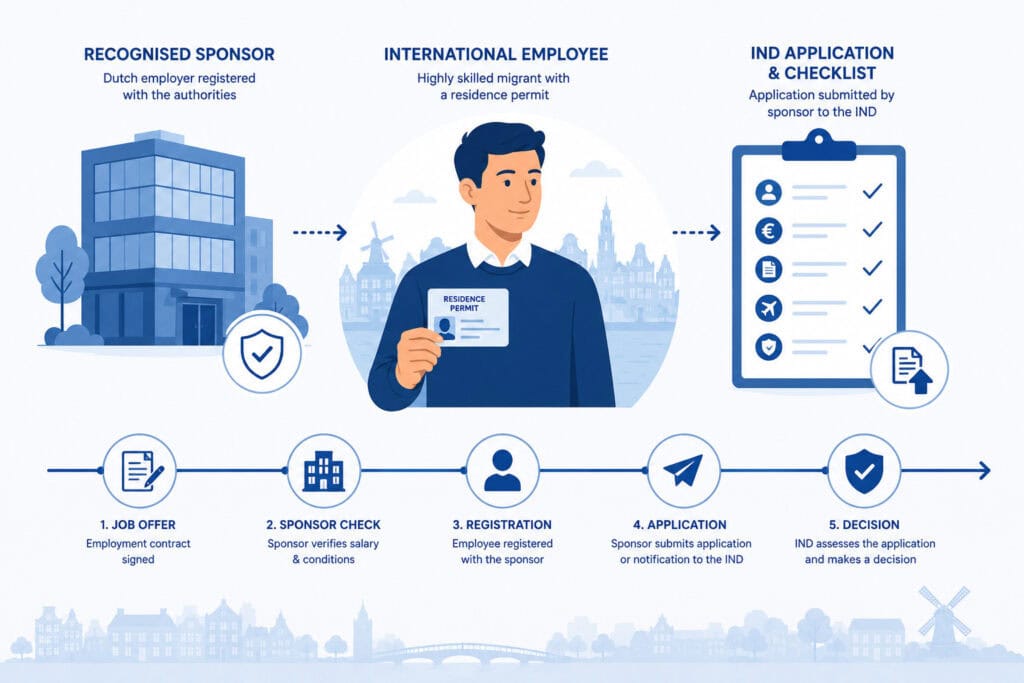
A highly skilled migrant residence permit is usually linked to employment with an employer recognised by the IND. The IND states that only an employer recognised by the IND can apply for this permit, and the migrant must generally have an employment contract with an employer or research institution in the Netherlands, meet income requirements and have a salary in line with the market rate.
This means job loss is not only an employment-law issue. It can also become an immigration-law issue.
If your employment ends, the IND does not necessarily revoke your residence permit immediately. Instead, the search period gives you time to find a new qualifying job.
The key point is that the search period is a maximum period, not an automatic guarantee until the end of your residence card.

3 months or 6 months: which search period applies?
The IND currently explains the rule as follows: if you lose your job while your highly skilled migrant residence permit is still valid, you have up to 3 months to find a new job. If you have had this permit for 2 years or longer, you have up to 6 months. The search period starts on the day your contract ends.
In practical terms:
- A highly skilled migrant with the permit for less than 2 years should usually plan based on a 3-month deadline.
- A highly skilled migrant who has held the permit for 2 years or longer may be able to rely on a 6-month search period.
- A person whose residence permit expires sooner than the 3-month or 6-month period will have a shorter period, because the search period cannot extend beyond the permit’s validity.
This is why the exact dates matter.
A small difference between a contract end date, a residence-card expiry date and a new employer’s start date can change the immigration risk significantly.
What changed under Directive 2024/1233?
Directive 2024/1233 is the revised EU Single Permit Directive. The IND has stated that the revised directive is relevant for several Dutch work-related residence purposes, including paid employment, work as a highly skilled migrant, the European Blue Card, research and orientation year residence.
The Directive contains important protection for single permit holders during unemployment. It states that unemployment alone should not be a reason to withdraw a single permit if the total unemployment period does not exceed 3 months during the validity of the permit, or 6 months if the third-country national has held the single permit for more than 2 years. It also refers to notification of the beginning and, where applicable, the end of unemployment according to national procedures.
For highly skilled migrants in the Netherlands, the practical starting point is now the current IND rule on the highly skilled migrant page: up to 3 months, or up to 6 months if the permit has been held for 2 years or longer.
This is an important development for highly skilled migrants who have been laid off, especially those who have already been working in the Netherlands for several years.
When does the search period start?
The search period starts on the day your employment contract ends. It does not usually start when you receive your last salary, when your employer informs the IND, or when you receive a letter from the IND.
This makes the termination date in a settlement agreement very important.
For example, if your settlement agreement says your employment contract ends on 1 September, the search period should normally be calculated from 1 September. If your last working day is earlier because you are placed on garden leave, the contract may still legally continue until the agreed end date.
However, garden leave can be complicated. You may still be employed, but you may also have restrictions on work, access, bonuses, holidays, pension, non-compete obligations and job-search freedom. For highly skilled migrants, garden leave should always be assessed together with the residence permit timeline.
Before signing a settlement agreement, check whether the proposed end date gives enough time for a new recognised sponsor to prepare and submit the necessary notification or application.
Your residence card expiry date can shorten the search period
The 3-month or 6-month search period cannot be longer than the validity of your residence permit.
This is one of the most common misunderstandings.
Example 1: your contract ends on 1 August 2026, your highly skilled migrant permit is valid until 1 December 2027, and you have held the permit for more than 2 years. You may have up to 6 months from 1 August 2026.
Example 2: your contract ends on 1 August 2026, but your residence permit expires on 1 October 2026. Even if you would otherwise qualify for a 6-month search period, your practical deadline may be much shorter because the residence permit expires first.
Example 3: your contract ends on 1 August 2026, and you have held the permit for only 18 months. You should not assume a 6-month period applies. Your case must be assessed based on the 3-month rule unless there is a separate legal reason to argue otherwise.
The safest approach is to calculate the deadline immediately after receiving notice of termination.

What must happen before the search period ends?
Finding a job is not always enough.
For a highly skilled migrant residence permit, the new employer normally needs to be an IND-recognised sponsor. The IND public register can be used to check whether an organisation is recognised as a sponsor, and the register is updated regularly.
The job must also meet the relevant salary and market-rate requirements. The IND states that required amounts for highly skilled migrants change every year on 1 January, and the applicable amount may depend on the date of application or, in a change of employer situation, the date the employment contract with the new employer starts.
This means you should check:
- whether the employer is a recognised sponsor;
- whether the salary meets the current highly skilled migrant salary threshold;
- whether fixed allowances can be counted;
- whether the start date is realistic;
- whether the employer knows how to submit the notification or application;
- whether your current residence card remains valid during the process.
Do not assume that a signed offer letter alone is enough. The IND process and sponsor action matter.
Can you work during the search period?
The search period gives you time to find qualifying work. It does not mean you have unrestricted access to every job in the Netherlands.
The work authorisation on a highly skilled migrant residence document allows work as a highly skilled migrant and self-employed work, while other work may require a work permit. The IND also states that if you only want to work as a self-employed person, you should apply for a self-employed or start-up residence permit.
In practice, this means you should be careful with interim work, freelance work, payroll constructions or work for a non-recognised employer.
A side activity may not solve the immigration issue if your main residence purpose is still highly skilled migrant employment and no new recognised sponsor is involved.
What if the new employer applies before the deadline but the IND has not decided yet?
Timing can be critical. The IND decision-period page refers to change-of-employer situations and explains that, where the current residence permit is still valid, a 45-day decision period may apply, with possible extension in special cases. For a change of employer combined with an extension, two periods may be relevant: 45 days while the residence permit is valid and 90 days for the extension.
Directive 2024/1233 also provides that where an unemployed single permit holder finds a new employer within the allowed unemployment period, and the Member State checks conditions for the new employment, the person should be allowed to stay until the competent authorities verify those conditions, even if the allowed unemployment period has expired.
This does not mean you should wait until the last day. Late applications can still create serious practical and legal risk.
A safer strategy is to have the new sponsor act as early as possible and to keep written proof of each step.
Common questions international employees ask online
“I was laid off. Do I have to leave the Netherlands immediately?”
Not necessarily. If your residence permit is still valid, the IND search period may give you time to find a new qualifying job. The period is usually up to 3 months, or up to 6 months if you have held the permit for 2 years or longer.
“I have worked in the Netherlands for more than 2 years. Does that automatically mean 6 months?”
Not always. The IND wording refers to having had this permit for 2 years or longer. If you changed residence purposes, had an orientation year, had a study permit, or had another type of residence before your highly skilled migrant permit, the timeline should be checked carefully.
“Does my search period start from the day I stop working or the contract end date?”
The IND states that the job search period begins on the day your contract ends.
This is why the exact wording of a settlement agreement matters.
“Can I wait until the last month to find a sponsor?”
This is risky. A recognised sponsor may need time to prepare documents, check salary criteria, confirm the start date and submit the required notification or application.
“Will this affect permanent residence or Dutch citizenship?”
It can. Permanent residence generally requires at least 5 consecutive years with a valid Dutch residence permit, main residence in the Netherlands, timely extensions and continued compliance with permit requirements. Naturalisation also generally requires 5 consecutive years with a valid residence permit, with timely extensions, unless an exception applies.
A residence gap can have consequences for later permanent residence or naturalisation procedures. The IND highly skilled migrant application form specifically warns that a residence gap can affect later permanent residence or naturalisation.
Settlement agreements: why immigration review matters
Many highly skilled migrants are offered a settlement agreement after redundancy, reorganisation or performance discussions.
From an employment-law perspective, the agreement may include severance, notice period, garden leave, legal budget, holiday payment, bonus, pension, laptop return, confidentiality and final discharge.
From an immigration-law perspective, several additional questions matter:
What is the official end date of the employment contract?
Will the employer report the end of sponsorship to the IND?
Does the agreement give enough time to find a new sponsor?
Does garden leave help or harm the job-search strategy?
Is the legal budget enough to cover immigration and employment review?
Could the termination date create a residence gap?
Is the employee close to permanent residence or naturalisation?
A settlement agreement should not be signed only from an employment-law perspective when the employee’s residence permit depends on the job.
For highly skilled migrants, the immigration consequences can be more important than the severance amount.
Practical examples
Example 1: less than 2 years as a highly skilled migrant
A software engineer has held a highly skilled migrant permit for 14 months. The employment contract ends on 30 September. The residence permit is valid until the following year.
In this situation, the employee should usually plan based on a maximum 3-month search period from 30 September. The employee should start approaching recognised sponsors immediately and check whether the new salary meets the current IND threshold.
Example 2: more than 2 years as a highly skilled migrant
A product manager has held a highly skilled migrant permit for 3 years. The contract ends on 1 October and the residence permit is valid for another 18 months.
In this situation, the employee may be able to rely on a maximum 6-month search period. However, the employee still needs a new qualifying employer, and the search period does not remove the need for recognised sponsorship and salary compliance.
Example 3: residence permit expires earlier
A data analyst has held a highly skilled migrant permit for 4 years. The contract ends on 1 October, but the residence permit expires on 15 December.
Even though the employee may otherwise fall under the 6-month category, the residence permit expiry date shortens the practical period. The employee should not assume they can stay until April without further action.
What should you do immediately after being laid off?
First, confirm the exact employment end date. Ask for the proposed settlement agreement, termination letter, employer communication and any document showing the official contract end date.
Second, check your residence card expiry date. The search period cannot go beyond the validity of the permit.
Third, calculate whether the 3-month or 6-month rule may apply to your case. Check the start date of your highly skilled migrant permit, not only your arrival date in the Netherlands.
Fourth, check whether your possible new employer is an IND-recognised sponsor. Use the public register and ask the employer directly whether they can act quickly.
Fifth, check the salary. The salary must meet the latest IND requirement and be in line with the market rate. Current thresholds must always be verified on the official IND page before signing the new contract or submitting an application.
Sixth, consider alternative residence routes. Depending on your situation, options may include a partner-based residence permit, EU Blue Card, self-employed route, start-up route, orientation-year-related options, Turkish citizen-specific arguments, or permanent residence if you already qualify.
Seventh, get legal advice before signing a settlement agreement if your residence position is uncertain.
Special note for Turkish citizens
The IND states on the highly skilled migrant page that other rules may apply to Turkish citizens and their family members.
This does not mean every Turkish citizen automatically has a different or better outcome. It means the legal assessment may require additional analysis, especially where Ankara Agreement-related rights, standstill arguments, labour market position, self-employment or long residence history may be relevant.
Turkish citizens who lose highly skilled migrant employment should not rely only on general online explanations. Their nationality and permit history may create additional legal arguments or strategic options.
Risks for family members
If your partner or children hold residence permits linked to your highly skilled migrant status, your job loss may affect them too.
This does not always mean immediate loss of residence rights, but it does mean the family’s position should be reviewed together. A new sponsor, a timely change of purpose or another residence route may be necessary to protect the whole family.
Families should be especially careful if children are in school, if a partner is working, if a home purchase or mortgage is involved, or if the family is close to permanent residence or naturalisation.
FAQ: Highly skilled migrant search period in the Netherlands
How long can a highly skilled migrant stay in the Netherlands after losing a job?
If your highly skilled migrant residence permit is still valid, the IND currently gives up to 3 months to find a new job. If you have held this permit for 2 years or longer, the period may be up to 6 months. The period cannot continue beyond the expiry date of your residence permit.
Do all highly skilled migrants get a 6-month search period?
No. The 6-month period is linked to having held the permit for 2 years or longer. Permit history should be checked carefully, especially if you previously had a study permit, orientation year permit, partner permit or another residence purpose.
When does the search period start?
The search period starts on the day your employment contract ends. It is important to confirm this date in your termination letter or settlement agreement.
What happens if my residence permit expires before the search period ends?
The residence permit expiry date shortens the search period. You cannot rely on a 3-month or 6-month search period beyond the validity of your permit.
Can the IND revoke my residence permit after the search period?
Yes. The IND states that if the search period is over and there is no registration by a new employer, the IND may revoke the residence permit.
Does a job offer stop the deadline?
A job offer helps, but it may not be enough by itself. For a highly skilled migrant permit, the new employer usually needs to be an IND-recognised sponsor and must take the necessary steps with the IND.
Does the new employer need to be a recognised sponsor?
As a general rule, yes. However, an exception applies to Turkish citizens. According to the IND, an employer does not have to be a recognised sponsor when employing a Turkish national as a highly skilled migrant, and the Turkish employee may submit the application personally. The other employment, salary and residence requirements continue to apply.
Can I work for a non-recognised employer during the search period?
Be careful. Highly skilled migrant work is tied to specific conditions. Other work may require a work permit, and work for a non-recognised employer may not protect your highly skilled migrant residence status.
Does garden leave count as unemployment?
Garden leave often means the employment contract is still formally continuing, even if you are released from work. However, the details depend on the agreement. The key date for the IND search period is usually the contract end date, so garden leave must be reviewed carefully before signing.
Can I switch to another residence permit if I cannot find a sponsor?
Possibly. Options depend on your nationality, partner situation, employment history, education, self-employment plan, salary, family circumstances and long-term residence position. This should be assessed before the search period is close to ending.
Will job loss affect permanent residence or Dutch citizenship?
It can if it causes a residence gap, late extension, permit withdrawal or failure to meet residence conditions. Permanent residence and naturalisation generally require consecutive lawful residence and timely extensions, subject to exceptions.
Should I get legal advice before signing a settlement agreement?
Yes, especially if your residence permit depends on your job. A settlement agreement can determine the contract end date, garden leave, legal budget, severance and timing. These points can directly affect your IND search period and immigration strategy.
Need advice after job loss as a highly skilled migrant?
If you have been laid off, offered a settlement agreement, placed on garden leave or warned that your employment may end, do not wait until the search period is almost over.
DYC Legal Consultancy assists highly skilled migrants, Turkish citizens, expats and international employees in the Netherlands with employment termination, settlement agreement review, IND search period calculations, recognised sponsor issues, permanent residence planning and alternative residence permit strategies.
Before signing documents or relying on a 3-month or 6-month deadline, get your situation reviewed based on your contract end date, residence card validity, permit history, salary, employer status and long-term immigration goals.
Related Articles and Official Sources
Highly Skilled Migrant Permit in the Netherlands – https://dyclegal.com/en/blogs/highly-skilled-migrant-permit-netherlands/
Foreigners and Immigration Law – https://dyclegal.com/en/practice-areas/foreigners-and-immigration-law/
Garden Leave and Non-Compete in the Netherlands – https://dyclegal.com/en/blogs/garden-leave-non-compete-netherlands/
Netherlands Settlement Agreements – https://dyclegal.com/en/blogs/netherlands-settlement-agreements/
Salary Requirements for Highly Skilled Migrants – https://dyclegal.com/en/blogs/2025-salary-requirements-for-highly-skilled-migrants/
Sick Leave Employment Law in the Netherlands – https://dyclegal.com/en/blogs/sick-leave-employment-law-netherlands/
Contact DYC Legal Consultancy – https://dyclegal.com/en/contact/
IND Highly Skilled Migrant – https://ind.nl/en/residence-permits/work/highly-skilled-migrant
IND Public Register Recognised Sponsors – https://ind.nl/en/public-register-recognised-sponsors/public-register-work
IND Required Amounts Income Requirements – https://ind.nl/en/required-amounts-income-requirements
IND Decision Periods – https://ind.nl/en/after-your-application/decision-periods
EUR-Lex Directive 2024/1233 – https://eur-lex.europa.eu/eli/dir/2024/1233/oj/eng
IND Residence Permit for Orientation Year – https://ind.nl/en/residence-permits/work/residence-permit-for-orientation-year
IND Obligations of Sponsor and Recognised Sponsor – https://ind.nl/en/obligations-of-sponsor-and-recognised-sponsor
Important legal note: This article provides general information and does not constitute individual legal advice. Immigration and employment consequences depend on factors including nationality, permit history, contract terms, residence-card validity and the timing of any new application. IND rules and salary thresholds may change, so the current official requirements should always be checked before taking action.